
Introduction: The Whisper of Wealth vs. The Shout of the Trend
Imagine the well-kept lawn of a multigenerational home in the Cotswolds or a terrace bathed in sunlight on the Amalfi Coast. The environment is quiet and the air is still. You notice someone on the other side. On their person, not a single logo is visible. They exude an unmistakable aura of established ease, dignity, and calm richness, even though you have no idea who created their attire.
Compare it to the hectic bustle of a downtown fast-fashion area. The designs are disorganized, the colors are dazzling, and the logos are displayed on chests like billboards.
There are other factors besides money that separate these two scenes. It is a comprehension of the materials.
The “Old Money” aesthetic and, more significantly, the enduring quality concept it embodies are never loud. It is not need to be. Its fundamental tenet is that apparel is an investment in oneself, meant to be used for years rather than just for a Saturday night Instagram post.
Understanding this attitude is essential in the realm of modest fashion, where dignity and grace are vital. Being modest involves more than just concealing one’s skin; it also involves the way the fabric interacts with the body. Does it cling in ways that are unflattering? Does it produce a greenhouse effect that is clammy? Or does it move, breathe, and skim with a graceful fluidity?
For millennia, the inheritors of style have learned this simple secret: fabric is everything.
A mansion cannot be built on a sand foundation, and a sophisticated wardrobe cannot be built on a polyester basis. This manual serves as your gateway to the sacred realm of excellence. In order to comprehend why certain clothing appears pricey despite its price tag and why others appear inexpensive, we are going beyond the obvious.
It’s time to master the language of wool, silk, and linen and comprehend why a synthetic reproduction will never fully capture the essence of the original.
Part 1: The Great Polyester Deception
The fashion industry has been pulling off a spectacular scam for decades. Customers have been persuaded that synthetic fibers, namely nylon, polyester, and acrylic, are interchangeable with natural materials. They promote them as “affordable,” “easy-care,” and “wrinkle-free.”
They are undoubtedly inexpensive to make, but your beauty bears the expense.
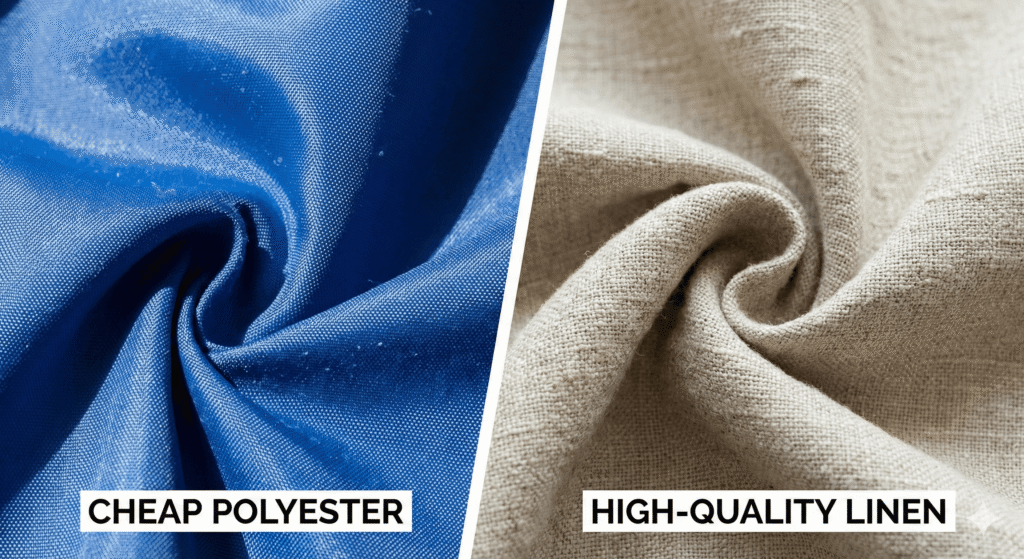
In essence, polyester is plastic. To make filaments, it is melted down from petroleum and then extruded through small holes. You are wrapping yourself in extremely fine plastic wrap when you wear polyester.
Why does it appear “cheap,” even when it’s fashioned into a high-end gown?
1. The Unnatural Shine
Natural fibers interact with light in complex ways. Wool absorbs light, giving it depth. Silk refracts light, giving it an internal glow or luster.
Polyester, being a smooth plastic filament, merely reflects light off its surface. This results in a flat, harsh shine often referred to as “sheen.” It’s the difference between the glow of a pearl and the shine of a plastic bead. In photography, and under harsh indoor lighting, polyester tells on itself immediately. It lacks the textural depth that signals quality.
2. The “Sweat Bag” Effect
Wearing clothing with more coverage or layering are common ways to be modest. This is a surefire way to cause discomfort when done with synthetics.
Natural fibers may absorb moisture from your skin and release it into the air because they are hydrophilic, or water-loving. Wool doesn’t feel wet even after absorbing up to 30% of its weight in water. Because linen breathes so well, air can flow through it.
Hydrophobic is polyester. Water is repelled by it. There is nowhere for the moisture to go when you perspire. It becomes trapped between the fabric’s plastic barrier and your skin. This causes fast bacterial development in addition to feeling damp and uncomfortable, which is why synthetic clothing smells stale far more quickly than natural clothing, even after washing. Being cooped up in a private sauna is not comfortable; true luxury is comfort.
3. The Cling and drape
How a fabric hangs on the body, its “drape”, is essential to an elegant silhouette.
Because synthetics are notorious for generating static electricity, they cling to the body in unflattering ways, outlining every curve and undergarment line rather than skimming over them. Natural fibers have weight and substance. A wool trouser falls cleanly from the hip to the shoe. A silk skirt moves like water. Polyester behaves like, well, cling film.
4. Aging Gracefully vs. Degrading Plastic
Longevity is valued in the “Old Money” culture. A grandfather may have given you a tweed jacket. After fifty washes, a linen shirt looks better than the first.
Synthetics deteriorate rather than age. High-friction areas, such as the underarms or the area where a handbag rubs against the hip, are prone to “pilling”—tiny, unattractive balls of fiber. The universal indicator of a cheap item of clothing nearing the end of its brief life is pilling.
Part 2: The Gatekeeper—How to Read a Label
You have to read the care label before you even try a garment on or look at the price tag. The single source of truth in the entire store is this small white tag, which is typically concealed in the inner side seam.
You may hear from the salesperson that it feels “silky.” For example, the marketing tag may read “premium blend.” However, the care label is legally obligated to disclose the precise content.
The foundation of the fashion philosophy is informed consumption.
The Guidelines for Participation:
First, disregard the “Touch Test”: Polyester may now be brushed and treated to appear deceptively soft in stores thanks to advancements in manufacturing technologies. After the first two washings, this softness goes away, exposing the rough plastic structure underneath. Until you have trusted your eyes on the label, do not trust your hand.
You’re searching for “100%” in the Percentages Game.100% Merino Wool, 100% Silk. All-linen.
The Peril of “Blends”: Blends are typically cost-cutting strategies, but occasionally they are required for performance (e.g., 2% elastane for stretch in jeans). A “Wool Blend” made of 20% wool and 80% acrylic is an acrylic sweater that is kept together by a wish, not wool. Make sure the natural fiber makes up the majority (at least 70%+) if you accept a blend.
Watch Out for Euphemisms: The business attempts to disguise synthetics under more appealing labels.
Nylon is polyamide.
Semi-synthetics (processed wood pulp) include viscose, rayon, and modal. Although they breathe and drape better than polyester, they are not as durable as real natural fibers and wrinkle easily. They are not top-tier investment pieces, but they are respectable mid-tier substitutes.
Polyurethane (plastic) is nearly always used in vegan leather. Within two years, it will peel and break.
If the labeling reads “100% Polyester,” return it to the rack. Disposable clothing is not what you deserve.
Part 3: The Trinity of Timelessness
Once you discard the synthetics, you are left with the materials that have clothed emperors, explorers, and icons of style for millennia. These fabrics require an investment—sometimes of money, always of care. But the return on that investment is a wardrobe that serves you, rather than the other way around.
A. Linen: The Uniform of Leisure and Sophistication
There is a reason why, in every film depicting the European aristocracy on holiday, everyone is wearing linen.
Linen is one of the oldest textiles in the world, made from the fibers of the flax plant. Its connection to “Old Money” lies in its association with leisure. Historically, linen was difficult to process and required constant pressing to look pristine. Wearing white linen implied you had the staff to maintain it and the lifestyle that didn’t involve manual labor.
The Magic of Linen:
- Unparalleled Breathability: Linen fibers are hollow, allowing maximum airflow. In high heat, nothing keeps you cooler. For the modest dresser in summer, a long-sleeved linen shirt or maxi dress offers sun protection without overheating.
- Tensile Strength: It is stronger than cotton and gets softer and more lustrous the more it is washed. A high-quality linen garment is a multi-decade commitment.
- The Textured Aesthetic: Linen has “slubs”—tiny, natural irregularities in the weave. These are not defects; they are marks of authenticity that give the fabric depth and character that flat cotton or polyester lacks.
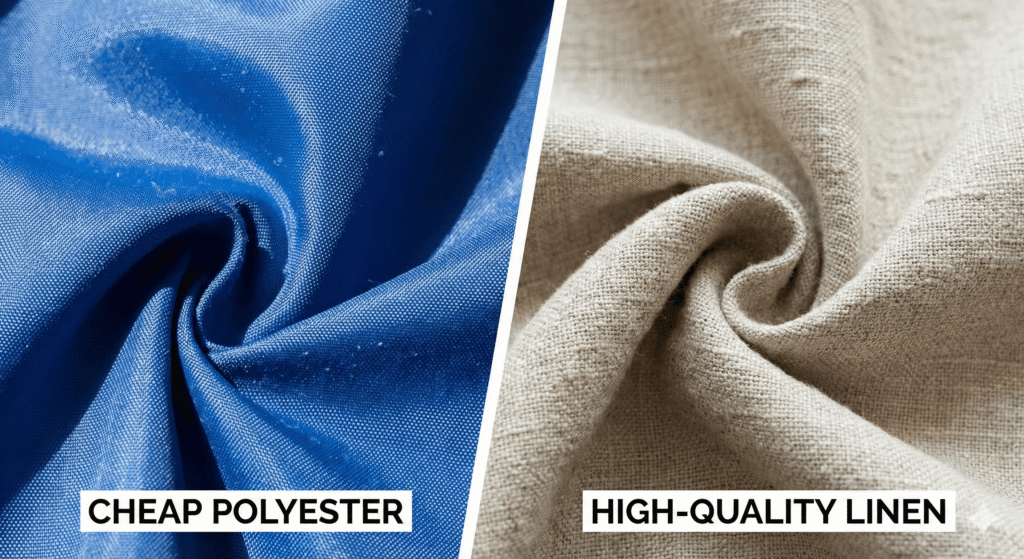
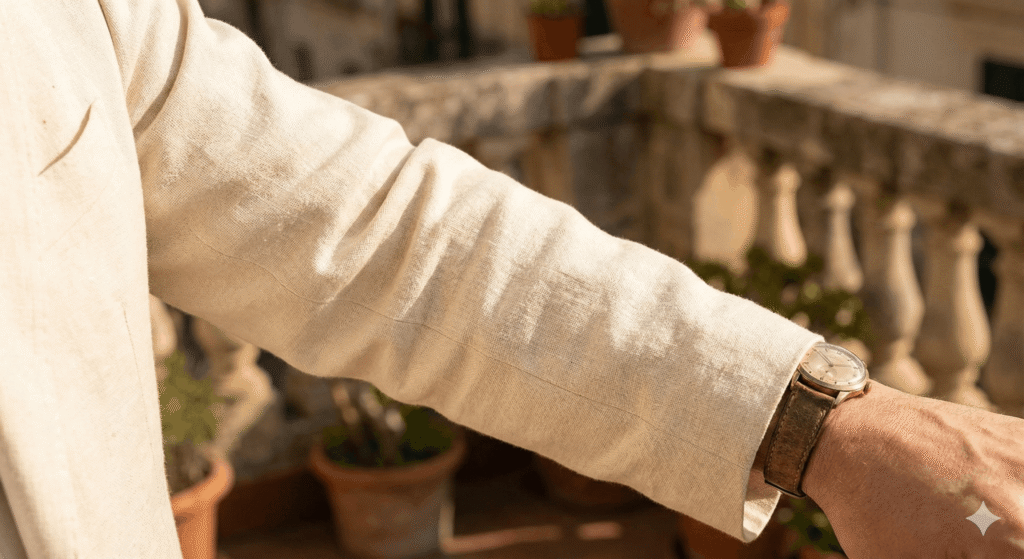
Embracing the Wrinkle: Many shy away from linen because it creases the moment you look at it. This is a mistake. In the echelon of true style, the wrinkles of fine linen are a badge of honor. They signify natural fiber. A garment that remains unnaturally flat looks rigid and cheap. The soft, rolling creases of worn linen show that you are living in your clothes, not just displaying them. It is a relaxed, confident elegance that says, “I am too comfortable to worry about a crease.”
B. Silk: The Drape of Emperors
If linen is the fabric of the sun, silk is the fabric of moonlight.
For thousands of years, silk—harvested from the cocoons of silkworms—was a closely guarded secret of the East, worth its weight in gold. It remains the ultimate signifier of luxury in evening wear and high-end modest fashion.
Why Silk is Unrivaled:
- The Internal Glow: As mentioned, silk’s triangular prism-like fiber structure refracts incoming light at different angles, producing different colors. This creates a shimmering, internal luster that synthetic satins try, and fail, to mimic.
- Thermal Regulation: Like wool, silk is incredibly good at maintaining body temperature. A silk blouse keeps you cool in summer but provides surprising warmth as a base layer in winter.
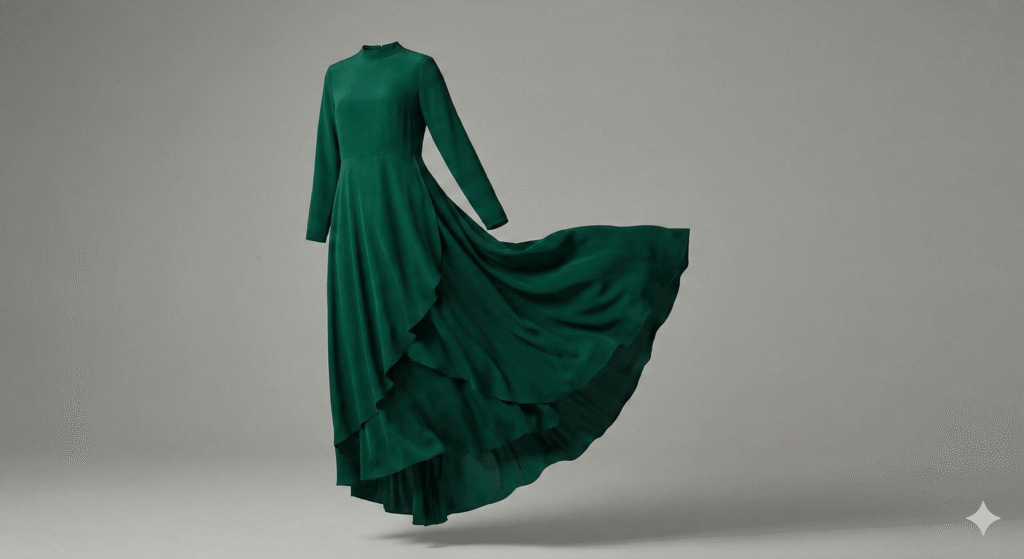
- The Fluid Drape: Silk has a tensile strength that rivals steel wire of the same diameter, yet it is incredibly fine. This allows it to be woven into fabrics that drape with a liquid consistency. A modest silk dress doesn’t hang; it flows around the body, creating an aura of graceful movement.
Navigating Silk Types: Not all silk is shiny.
- Charmeuse or Satin Silk has that high-wattage luster perfect for evening wear.
- Silk Crepe de Chine has a matte, pebbled texture, incredible durability, and is perfect for understated, day-to-day elegance.
- Raw Silk (Silk Noil) has a nubby, matte texture similar to cotton but with better drape, excellent for blazers and trousers.
Investing in silk means committing to hand-washing or dry cleaning. But the feeling of pure silk against the skin is an experiential luxury that polyester can never replicate.
C. Wool: The Backbone of Structure and Longevity
When we think of “Old Money” staples—the tailored blazer, the winter coat that lasts twenty years, the perfect pleated trouser—we are thinking of wool.
Wool is the hair of sheep (or goats, in the case of cashmere, and camelids for alpaca). It is nature’s most technically advanced performance fiber.
The Science of Wool:
- Structure and Memory: Wool fibers are crimped like tiny springs. This gives wool fabric natural elasticity and “memory.” A high-quality wool suit jacket will conform to your body shape over time but snap back to its original structured form after resting on a hanger. Synthetics eventually sag and lose their shape.
- The Ultimate Insulator: Wool fibers trap air pockets, creating a thermal barrier. It keeps warmth in without stifling the wearer.
- Odor Resistance: Wool is naturally antimicrobial. You can wear a wool sweater many times before it needs washing, unlike synthetics which hold onto body odors aggressively.
The Hierarchy of Wool:
- Merino: The gold standard for next-to-skin softness. Fine Merino wool is not itchy; it is incredibly soft, breathable, and suitable even for summer weight tailoring (look for “Cool Wool” or “Tropical Wool”).
- Cashmere: Actually hair from the Cashmere goat. It is softer, lighter, and three times more insulating than sheep’s wool. True “Old Money” cashmere is dense, multi-ply, and rarely pills. Cheap cashmere is thin, loosely woven, and pills immediately.
- Tweeds and Heritage Weaves: Fabrics like Harris Tweed are thick, coarse, and virtually indestructible. They evoke the landed gentry aesthetic because they were designed for rugged outdoor pursuits while maintaining a tailored appearance.
A modest wardrobe built on wool trousers, tailored blazers, and fine knitwear is a wardrobe that commands respect through its very structure.
The Fashiorial Approach to Modesty
There is a deep connection between natural fibers and modest fashion. Modesty is about having dignity, and there isn’t much dignity in being wrapped in sweaty, clingy plastic.
The “Old Money” look isn’t about copying a social class; it’s about having fewer, nicer stuff. It says no to the fast fashion cycle and yes to clothes that are good for the environment, the artisan, and most importantly, the person who wears them.
When you wear a heavy silk skirt that billows about your ankles or a pristine linen shirt that keeps you cool while you’re covered, you’re saying that you care more about quality than convenience and substance than flair.
Reading labels is how you protect yourself from an industry that wants to offer you less for more. Ask for the best materials. Learn how to take care of them. See how they become older in a wonderful way next to you. That’s what real style is all about.