
The 3 Accessories That Make Any Outfit Look ‘Dark Academia’ Instantly
Introduction: The Secret Society of Style
Dark Academia captures a vibe that no other style does. It smells like old paper and wet pavement. At midnight, the university library is very quiet. It makes study, secrecy, and the search for truth seem romantic.
But here’s a secret that mood boards and Pinterest algorithms don’t often tell you: you don’t have to completely change your closet to get into this world. You don’t have to go to a Gothic university in the 1800s.
You only need the right things.
We at Fashiorial think that style is a way of speaking. Dark Academia thinks when “Old Money” whispers. It has a cerebral look about it. It tells the world that you are a person of substance, someone who reads classic books and writes poetry in the margins. And like any secret society, it has its own signs. For example, totems that show you are a member as soon as you wear them.
You could be wearing a plain black abaya or a plain beige trench coat and jeans. You are no longer just a pedestrian if you add the Holy Trinity of Dark Academia accessories: The Wireframe, The Satchel, and The Loafer. You are a student going to a lecture about Romantic poets.
This guide is like your syllabus. We’re not just making a list; we’re looking into the heart of these accessories. We will show you why they work, how to pick the best investment-grade ones, and how to use them to make the ordinary seem magical.

I. The Intellectual’s Shield: Eyewear as Identity
In the world of Dark Academia, seeing is everything. It’s about how you perceive the world and how the world sees you. Here, glasses are not just a medical necessity; they are the “Intellectual’s Shield.”
Eyewear has always been a sign of intelligence in the past. From the monocles of 19th-century scholars to the hefty horn-rims of mid-century writers, glasses put a barrier between the wearer and the outside world. They say, “I am watching.”
For people who dress simply, glasses have two uses. They bring attention right away to the face, the eyes, and the mind. They shape the mind.
The Archetypes of Frames
To achieve the aesthetic, you cannot simply grab any pair off the rack. You must choose a frame that tells a story.
- The Gold Wireframe (The Poet) This is the quintessential Dark Academia choice. Delicate, almost fragile, it evokes the image of a WWI poet writing letters from the front, or a student poring over ancient Greek texts by candlelight.
- Why it works: It adds a layer of vintage nostalgia without dominating the face. It pairs beautifully with hijabs in warm tones (rust, cream, espresso) because the gold reflects the fabric’s warmth.
- The Fashiorial Tip: Look for round or “panto” shapes (round with a slightly flattened top). Avoid harsh rectangles, which read more “corporate office” than “dusty library.”
- The Tortoiseshell Acetate (The Professor) If wireframes are for the student, tortoiseshell is for the tenured professor. This pattern, mottled browns, ambers, and blacks, is chaotic yet organic. It mimics nature.
- The Material Science: True high-end acetate is plant-based (cotton and wood pulp), unlike cheap plastic. It has a depth of color that glows when backlit.
- Styling: These are bolder. They demand to be taken seriously. They pair exceptionally well with structured blazers and heavy wool coats.
- The Clear/Crystal Frame (The Modernist) For those who want the vibe but feel overwhelmed by heavy frames, clear acetate offers a ghostly, ethereal quality. It is Dark Academia with a touch of sci-fi, the scholar of the future.
The “Fake” Glasses Debate
Is it acceptable to wear “plano” (non-prescription) lenses for the aesthetic? Absolutely. In this context, glasses are an accessory akin to a necklace or a watch. They style the face. However, ensure the lenses have an anti-reflective (AR) coating. Nothing ruins the mystique faster than cheap plastic lenses that reflect the ring light you’re using to film your “Study with Me” vlog. The eyes must be visible.

II. The Vessel of Knowledge: The Leather Satchel
If you are a scholar, you carry burdens. You carry books, journals, a laptop, and perhaps a thermos of black coffee. You need a vessel.
The modern backpack is functional, yes. It distributes weight evenly. It is practical. But it is also aesthetic poison. A nylon backpack screams “hiker” or “commuter.” It breaks the line of your coat. It ruins the silhouette of an abaya.
Enter the Satchel.
The satchel is the cornerstone of the Dark Academia silhouette because it represents history. It mimics the mail carriers of the 1920s, the schoolbags of the 1950s, and the briefcases of the literary elite. It is structured, rigid, and unapologetically classic.
The Anatomy of the Perfect DA Bag
To make the outfit work instantly, the bag must adhere to specific structural rules.
- The Leather Requirement We spoke of materials in our “Old Money” guide, and it applies here tenfold. The bag must be leather (or a high-grade, thick vegan alternative that mimics the stiffness of bridle leather).
- Why: Soft, slouchy bags look casual and bohemian. Dark Academia is about rigor and discipline. The bag should be able to stand up on its own when you set it on the library floor.
- The Aging Process: You want a leather that patinas. Scratches on a Dark Academia satchel are not damage; they are battle scars from your academic journey. A pristine bag looks suspicious; a battered bag looks loved.
- The Hardware Brass. Antique Brass. Copper. Avoid shiny chrome or silver, which looks too modern and “tech-focused.” The hardware should look like it could be the handle of a Victorian door. Buckles are preferred over zippers. The act of unbuckling your bag to retrieve a book is a ritual in itself—it slows you down, making the movement deliberate and elegant.
- The Shape and Wear The bag should be rectangular and carried either by a top handle (briefcase style) or a long crossbody strap.
- For the Modest Dresser: The crossbody satchel is a powerful tool. It breaks up the fabric of a long coat or abaya, adding a visual waistline or a diagonal line that adds interest to a monolithic outfit.
- Color Palette: Oxblood (deep burgundy), Espresso Brown, and Pitch Black. Tan is acceptable, but darker shades read more “moody” and “academic.”
The “Fashiorial” Test: Ask yourself: Could this bag hold a hardcover edition of ‘The Secret History’ and a fountain pen without bending the pages? If the answer is no, it is a purse, not a satchel. Put it back.

III. The Scholar’s Stride: The Loafer
Shoes are what make an outfit. They are the finish of the sentence.
You can wear a nice trench coat and a cashmere sweater, but if you wear neon running shoes with them, the look is ruined. You are no longer a mysterious student; you are just a person doing errands.
The Loafer is the only type of shoe that works with this style. It doesn’t have a gender, it never goes out of style, and it fits nicely between formal and casual.
The Genealogy of the Loafer
- The Penny Loafer The classic. Defining feature: a leather strap across the front with a slit (where students used to keep a penny for a phone call).
- The Vibe: Preppy, Ivy League, neat. This is for the “good student” look.
- Styling: Wear these with white socks. The contrast between the black leather and the white sock is iconic. It draws the eye down and adds a touch of innocence to the dark outfit.
- The Tassel Loafer The eccentric cousin. Defining feature: decorative tassels hanging from the front.
- The Vibe: Artistic, slightly chaotic, poetic. This is for the art history major or the creative writer.
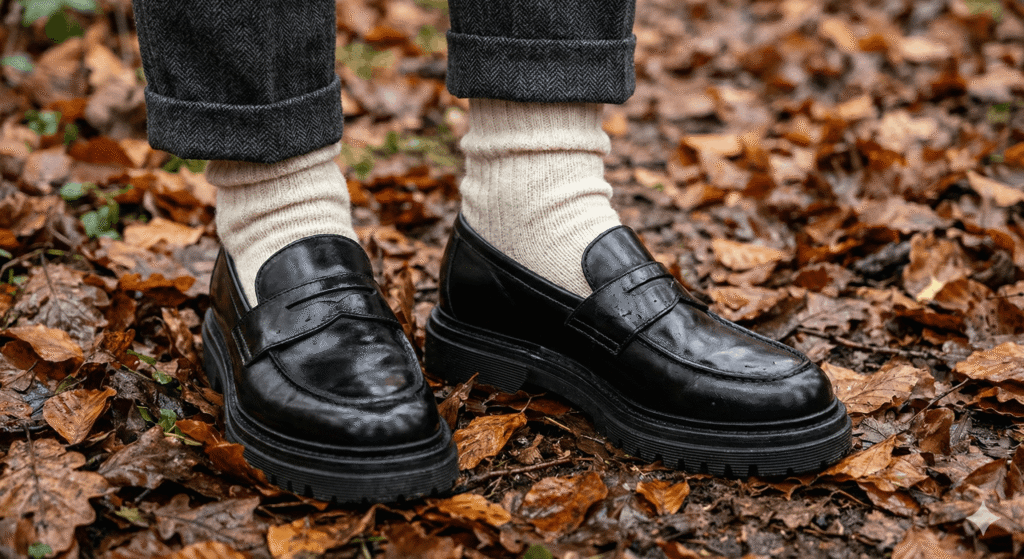
- The Chunky “Lug Sole” Loafer (The Modern Twist) This is where 1950s prep meets 1990s grunge. Brands like Dr. Martens or Prada popularized the loafer with a heavy, thick rubber sole.
- Why it dominates Dark Academia: It adds edge. A delicate loafer can sometimes look too dainty or “costume-like.” A chunky loafer gives the outfit weight. It says you are ready to stomp through rainy London streets.
- Modesty Factor: The chunky sole adds height and presence. It balances out the volume of wide-leg trousers or maxi skirts effectively.
The Sock Equation
In Dark Academia, socks are not underwear; they are an accessory. You must not wear “no-show” socks with loafers in this aesthetic. The ankle must be dressed.
- The Texture: Ribbed wool, cable knit, or sheer lace.
- The Color: Mustard, forest green, charcoal, or stark white.
- The Look: A slightly slouchy sock peeking out from a long skirt or cuff of a trouser adds a layer of “cozy intellectualism” that is irresistible.
IV. Putting It Together: The Fashiorial Formulas
Now that you possess the Trinity—The Glasses, The Satchel, The Loafer—how do you apply them to your existing wardrobe to create that instant Dark Academia magic?
Here are three scenarios. Notice how the clothes are basic, but the accessories do the work.
Scenario A: The Library Ghost
- The Base Outfit: A simple black abaya or a black turtleneck and black maxi skirt. On its own, this is just… black clothes.
- The Transformation:
- Feet: Chunky black loafers with white socks (high contrast).
- Bag: A distressed brown leather crossbody satchel (adds earthiness).
- Face: Gold wireframe glasses.
- The Result: You are no longer wearing “basics.” The accessories have contextualized the black outfit as “existentialist chic.” You look like you are mourning a Victorian monarch.
Scenario B: The Tenured Professor
- The Base Outfit: A beige trench coat over jeans and a white shirt. Very standard.
- The Transformation:
- Feet: Oxblood Tassel Loafers.
- Bag: A rigid briefcase-style satchel held in hand, not worn on the shoulder.
- Face: Tortoiseshell acetate glasses.
- Head: A hijab in a dark plaid or houndstooth print.
- The Result: Authority. The structure of the bag and the boldness of the glasses turn a casual trench coat into “detective/professor” attire.
Scenario C: The Late Night Writer
- The Base Outfit: An oversized brown cardigan and loose trousers. Pajama-adjacent comfort.
- The Transformation:
- Feet: Sleek penny loafers (slippers of the outdoor world).
- Bag: A satchel overflowing with notebooks, left open slightly.
- Face: Slightly oversized clear frames.
- The Result: “Messy Academic.” You look too busy discovering a breakthrough theory to dress up, yet you look stylish by accident.
V. The Philosophy of the “Totem”
Why does this work? Why do these three items hold so much power?
It is because Dark Academia is, at its core, a form of roleplay. It is a way of romanticizing the act of learning. When you put on the glasses, you focus better. When you carry the satchel, you feel the weight of your potential. When you wear the loafers, you walk with purpose.
This is the Fashiorial “Accessory Hack.” You do not need a billion-dollar wardrobe to look like a billion-dollar scholar. You simply need to understand the semiotics of style.
By investing in these three items, you are buying a ticket to a world of your own creation—a world where the library is always open, the coffee is always hot, and you are the main character in a novel that hasn’t been written yet.
So, put on your wireframes. Buckle your satchel. Slip into your loafers. The lecture is about to begin.
A Note on Sourcing (The Hunt)
Do not rush to Amazon to buy cheap replicas of these items. The soul of Dark Academia is authenticity.
- For the Satchel: Thrift it. Go to eBay or Etsy and search for “Vintage leather school bag” or “70s briefcase.” The wear and tear is what you are paying for.
- For the Loafers: Look for heritage brands like Bass Weejuns or Solovair. Or, find a high-quality vintage pair and have them resoled by a cobbler.
- For the Glasses: If you don’t need a prescription, invest in a quality frame from a dedicated eyewear brand and pay the extra $30 for high-quality clear lenses. Do not wear the plastic “demo” lenses that come with the frames; they have stamps on them and reflect light poorly.
Quality is the aesthetic.