
How to Style the 'Old Money' Aesthetic With a Hijab (Without Looking Frumpy)
By Fashiorial
If you have ever wondered, “How does she do it?” when you see a woman walking down the street who is entirely covered but emanates an air of effortless wealth and quiet confidence, this is the most important thing you will read today. Let’s be honest for a moment.
One of the main issues with modest fashion is the “Frump Factor.”
We construct layers. We offer coverage. We rolled up our sleeves. And by the time we leave the house, we often don’t look like the sophisticated, smart women we are. Clothes seem to be drowning us. We look “heavy.”
We look disorganized. But there is a style language that offers a quick fix for this problem, a hidden code. The “Old Money” appearance is the term for it. Disregard the TikTok trends. Disregard the logos. “Old Money” does not aim to spend a fortune.
It has to do with a certain set of rules, unwritten rules, that reflect quality rather than cost. Amazing things happen when modest clothes are dressed according to these rules. Instead of looking like clutter, the “layers” start to resemble drapes.The “coverage” starts to seem more like a choice than a restriction.
Today, I’ll give you the keys to the castle. I’ll show you how to wear a hijab like the Old Money with the Five Iron Rules. According to these secrets, “covered up” becomes “high society.”

Rule #1: The "Column of Color" Technique
Take this, if nothing else, from this guide. This is the ultra-wealthy, First Ladies, and royalty’s secret weapon.
The fastest way to look “frumpy” is to chop your body into blocks. A black skirt, a white top, a grey cardigan, and a pink hijab. Your eye doesn’t know where to look. You look shorter. You look wider. You look busy.
The “Old Money” modest woman uses the Column of Color.
This means wearing one tone from head to toe. When you wear a cream hijab, a cream cable-knit sweater, and cream wide-leg trousers, you create a single, unbroken vertical line.
This does two powerful things:
- It Elongates You: You instantly look three inches taller and ten pounds lighter.
- It Screams “Intentional”: Matching tones requires planning. And in the language of style, planning equals wealth.
The “Rich Girl” Palette: You don’t need to wear boring beige. But you must stick to the “Heritage” palette:
- The Ivories: Cream, Oatmeal, Vanilla, White.
- The Navy: Deep Midnight Blue (Never royal blue).
- The Forest: Deep Emerald, Olive.
- The Earth: Camel, Chocolate, Terracotta.
Insider Tip: If you can’t match the colors perfectly, simply keep them in the same “temperature.” Warm beige pants go with a warm cream sweater. Do not mix cool greys with warm browns.
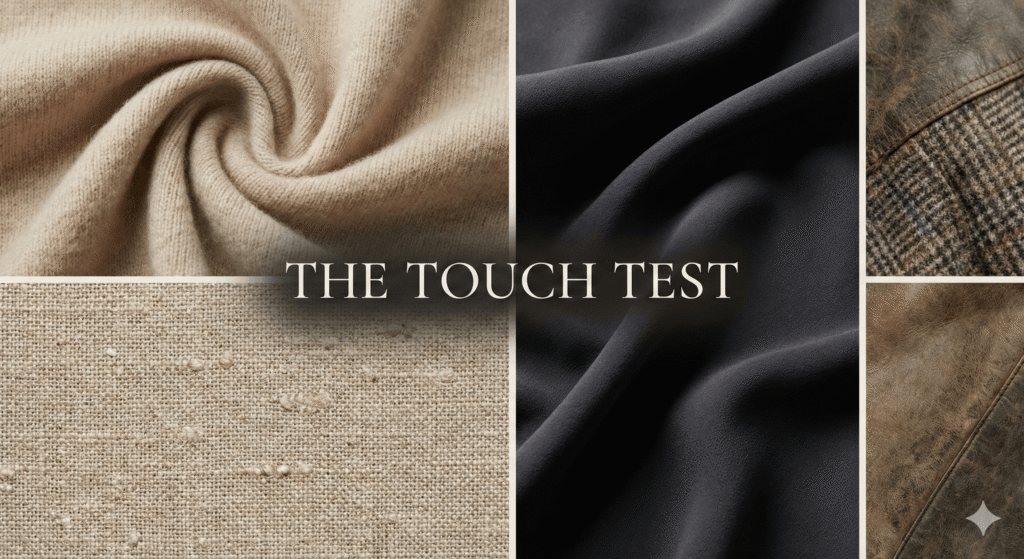
Rule #2: The Fabric "Touch Test" (Death to Polyester)
Fashion bloggers won’t tell you this hard reality: Cheap polyester does not look Old Money.
Texture is the foundation of the overall aesthetic. Since we conceal our skin as modest dressers, the fabric itself serves as the “skin” of our ensemble.
“Old Money” is about natural fibers, thus the illusion is destroyed if the cloth pills after one wash, clings with static, or shines under fluorescent light. It has to do with breathable clothing.
The “Yes” List:
- Cotton Poplin: Crisp, stiff, and holds its shape. Perfect for oversized shirts.
- Linen: Even when wrinkled, linen looks expensive. It implies you are on vacation.
- Wool & Cashmere: They absorb light rather than reflecting it. They look soft and heavy.
- Matte Silk: Not shiny satin (which looks like lingerie), but heavy, matte silk.
The “No” List (The Frump Makers):
- Jersey: Unless it is very high quality, jersey clings to lumps and bumps.
- Shiny Polyester: It looks like plastic. Avoid at all costs.
- Distressed Denim: Old Money denim is dark, solid, and has no holes.
The Test: Close your eyes and touch the fabric. Does it feel “dry” and textured (like linen/wool)? Or “slippery” and “squeaky” (like poly-blends)? If it squeaks, put it back.
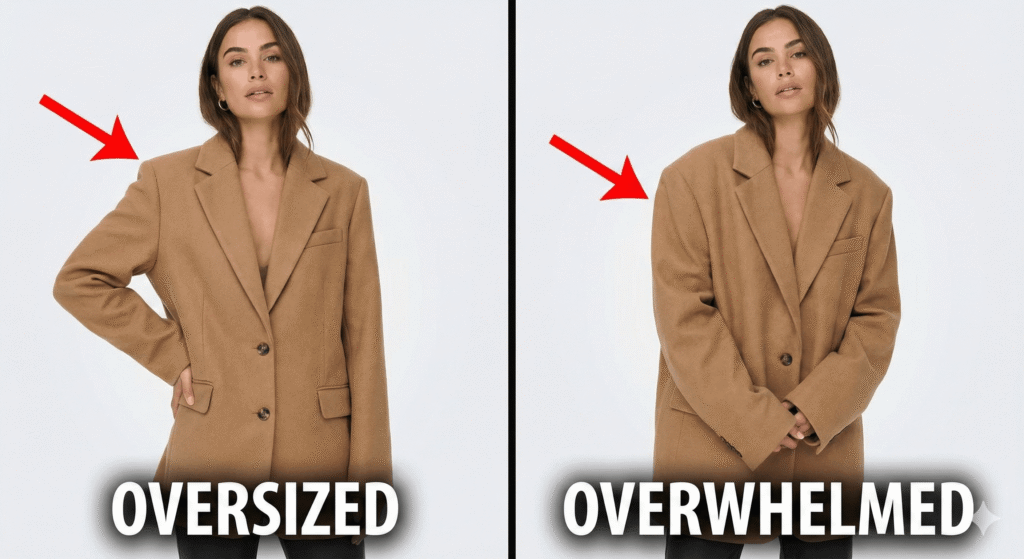
Rule #3: The "Volume Equation" (Oversized vs. Overwhelmed)
This is where 90% of hijabis fail.
We love “oversized” because it is modest. But there is a fine line between looking “chic oversized” (The Olsen Twins) and “I borrowed my dad’s suit” (Frumpy).
The Old Money aesthetic relies on Tailoring. Even their loose clothes are tailored.
The Golden Ratio of Volume:
- If you wear something loose on top, you must wear something structured on the bottom.
- If you wear something loose on the bottom, you must wear something structured on top.
- Wrong: Wide-leg pants + Oversized Hoodie + Giant Scarf = A shapeless blob.
- Right: Wide-leg trousers + A tucked-in crisp shirt + A belt.
The Shoulder Secret: As long as the shoulders fit, you can wear a blazer that is three sizes too large. You appear sloppy rather than modest if the shoulder seam is falling down your bicep. The shoulder’s structure “frames” the rest of the ensemble’s modesty.
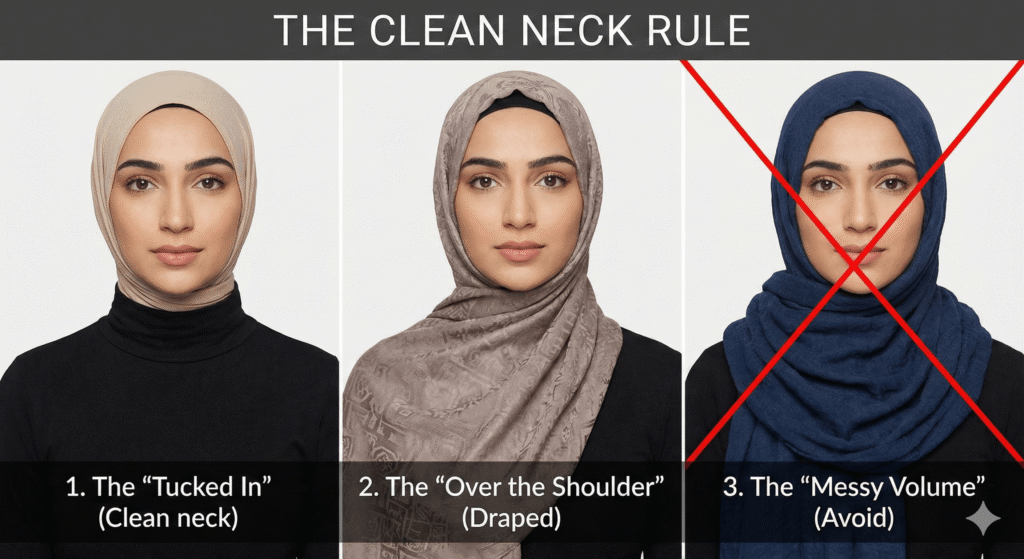
Rule #4: The "Clean Neck" Theory
How you style your hijab can make or break the Old Money look.
If you look at photos of Jackie Kennedy or Princess Grace (who often wore headscarves), you will notice one thing: You can see their neck (or the silhouette of it). Now, for us, we cover the neck. But we must simulate that “cleanliness.”
Bulky, voluminous hijab styles that bunch up around the neck ruin the lines of your outfit. They hide the collar of your beautiful trench coat. They fight with your jewelry.
The 2 Approved “Old Money” Hijab Styles:
- The “Kelly” Tuck: A silk square scarf or chiffon rectangle, tied tightly and tucked inside your shirt or turtleneck. This reveals the collar of your blazer and elongates your neck. It is severe, chic, and very high-fashion.
- The “Drape” (Chiffon only): One side thrown effortlessly over the shoulder. It moves when you walk. It creates vertical lines.
Avoid: The “flower” bun on the side of the head, or excessive layers of jersey wrapped three times. “Old Money” whispers; it doesn’t shout.
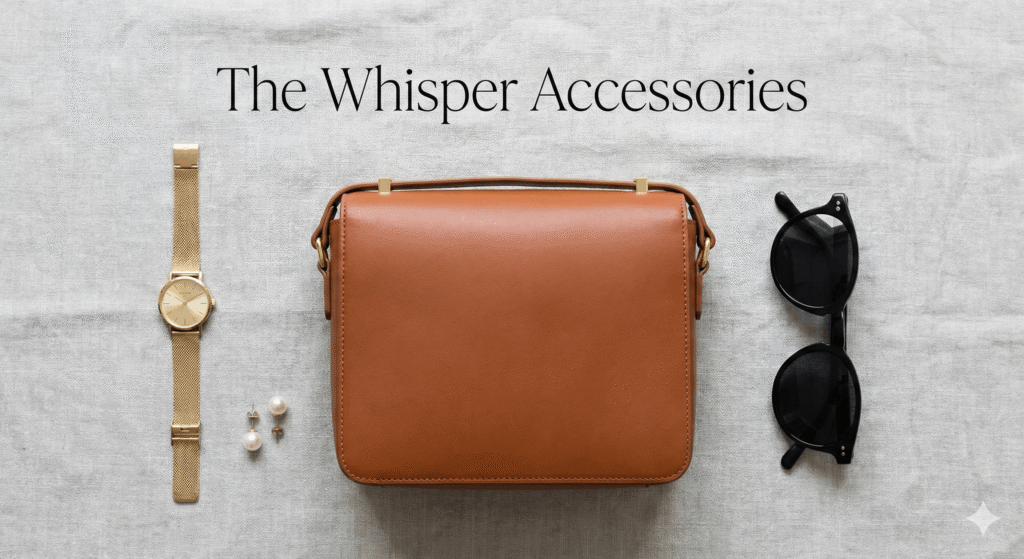
Rule #5: Accessories that Whisper (Logomania is Dead)
Nothing screams “New Money” (or “No Money”) louder than a giant Gucci belt buckle or a bag covered in LV monograms.
The “Old Money” aesthetic is about Stealth Wealth. It is the confidence of knowing your bag is leather, without needing to write the brand name on it for everyone else to see.
The Modest Accessory Checklist:
- The Watch: A small, gold or silver tank watch (square face). It signals you value time.
- The Bag: Structured leather. Slouchy bags look messy. A structured bag (like a box bag or a tote) adds architectural lines to your modest outfit.
- The Sunglasses: Black or Tortoiseshell. Cat-eye or Wayfarer. No mirrored lenses.
- The Jewelry: Gold hoops. A single pearl necklace. A signet ring.
- The Hijab Pin Hack: Stop using giant, colorful plastic pins. Switch to “magnet pins” that are invisible, or use straight pins that hide in the folds. The mechanics of your outfit should be invisible.
It’s Not About the Price Tag
You can buy a linen shirt at a thrift store for $5. You can buy a cream skirt at Walmart. If you wash them, iron them crisp, and wear them together with a clean hijab style, you will look like you just stepped off a private jet in the Hamptons.
The “Old Money” aesthetic is not about wealth. It is about discipline.
It is the discipline to say “No” to the neon trend. The discipline to iron your clothes. The discipline to coordinate your colors.
And that, my friends, is the true essence of modest fashion. It is intentional. It is dignified. And it is timeless.