
Storing 50+ Scarves: The ‘KonMari’ Folding Method for Small Drawers
It’s 7:48 AM. You are already ten minutes late.
You yank on the edge of that perfect crimson pashmina buried at the bottom of the stack. Disaster strikes. The “Avalanche” happens. Five other scarves tumble out with it, tangled in a messy, wrinkly heap on the floor. The drawer won’t close. The clock is ticking. You can feel the heat rising in your cheeks.
We know that panic. We have felt that frustration.
If you are struggling with storing 50+ scarves: The ‘KonMari’ folding method for small drawers is the life-changing solution you have been waiting for.
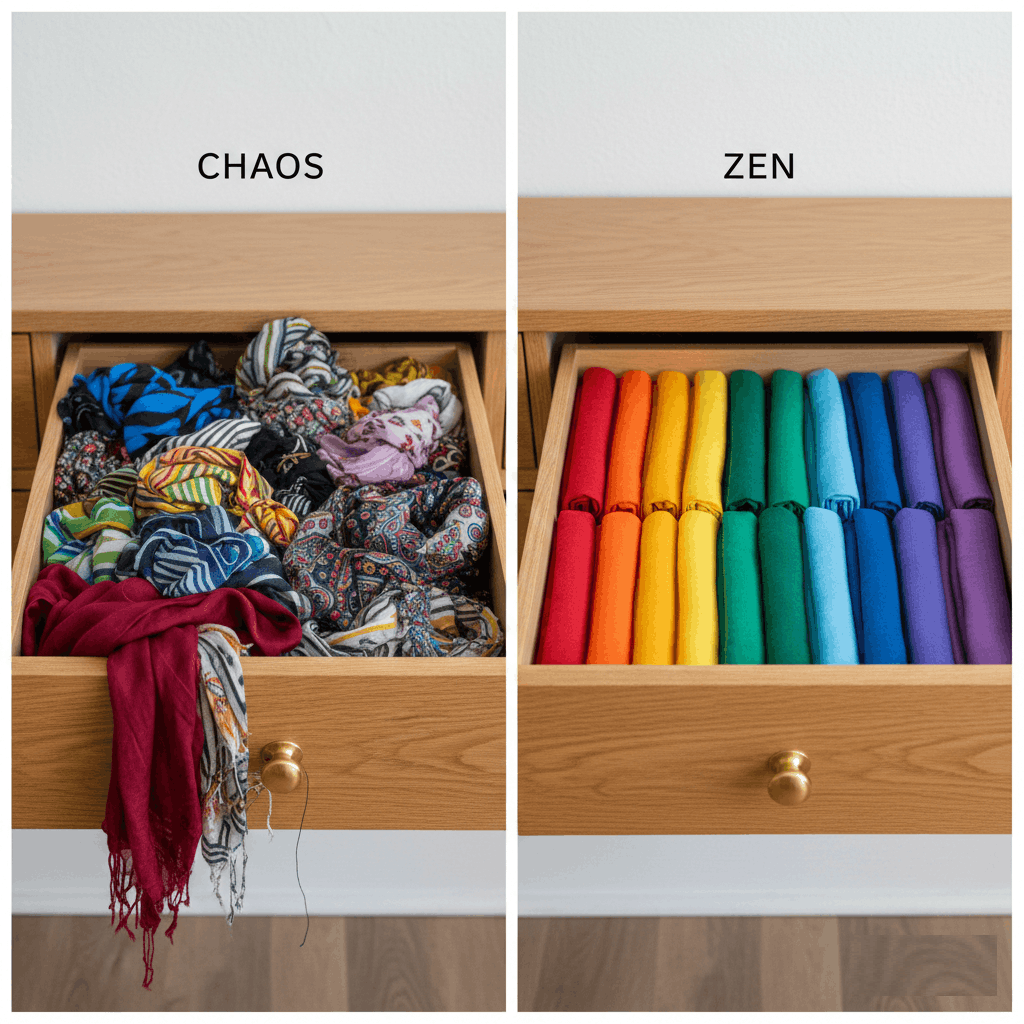
Most people think the problem is that they have too many clothes. That isn’t true. The problem is that you are stacking them like pancakes instead of filing them like important papers. When you stack, you can’t see what you own. And what you can’t see, you don’t wear.
In this guide, we are going to take you from a chaotic “scarf mountain” to a zen-like boutique display. You will reclaim your space, your sanity, and your mornings.
Wait, do you have slippery satins that refuse to stay folded? Don’t worry. We reveal the “Cardboard Sandwich” hack in Section 6 that fixes this instantly.
Why Your Current System is Failing You
The old way of doing things is broken.
If you are like most of us, you probably use the “Stack and Pray” method. You fold a scarf, place it in the drawer, and put another on top. It works for the first three items. But once you hit scarf number 50, you are in trouble.
Here is why the stack fails:
- The Weight: The bottom layers get crushed. This creates deep, stubborn creases that no amount of steaming seems to fix.
- The Blind Spot: You only wear the top 20% of your collection because you literally forget the bottom 80% exists.
- The Mess: pulling one item out disrupts the entire ecosystem.
We are going to flip the script, literally. We are moving from horizontal to vertical.
What is the KonMari Method?
You have likely heard of Marie Kondo. She is the tiny powerhouse who taught the world to tidy up.
Her philosophy is simple: keep only what “sparks joy.” But her technical contribution is even better. It is called “File Folding.”
Instead of laying items flat, you fold them into a small, tight rectangle that stands up on its own. It looks like the spine of a book. When you open your drawer, you see every single color, pattern, and texture at a glance.
The Benefits for Scarf Hoarders
- Zero Wrinkles: There is less pressure on the fabric.
- Visual Bliss: It looks like a rainbow in a box.
- Capacity: You can fit 2x to 3x more items in the same space.
Note: This method works best for drawers that are 4 to 8 inches deep. If your drawers are shallower, we have a modification for that below.
How to Execute the KonMari Fold (The Master Technique)
This is the core of the system. It is time to get your hands moving. Grab your bulkiest scarf and let’s practice.
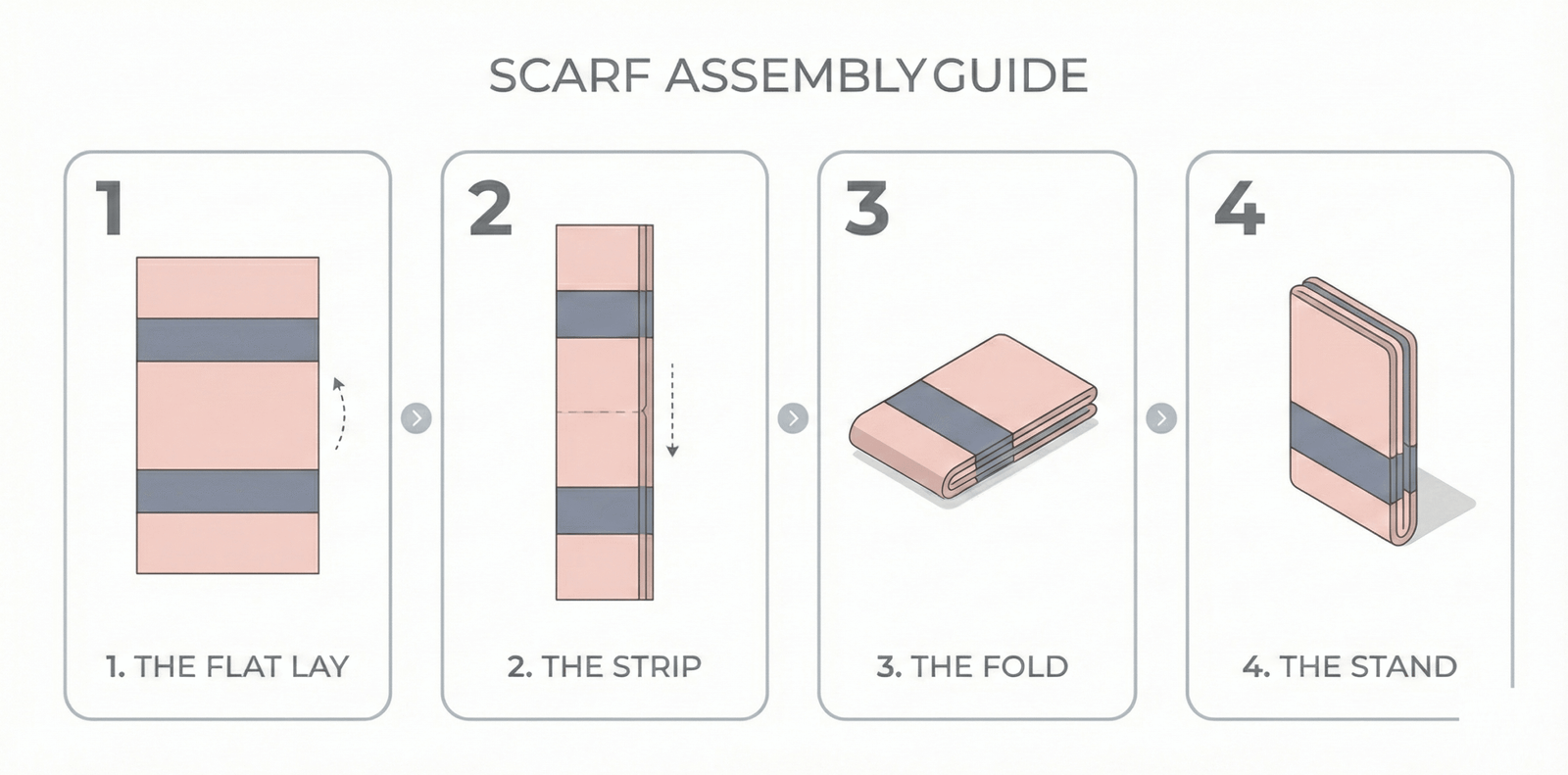
The best way to master storing 50+ scarves: The ‘KonMari’ folding method for small drawers is to fold the item in half lengthwise, fold the sleeves or edges in to create a long rectangle, and then fold that rectangle in half or thirds until it stands upright on its own. This works because it creates a stable base that resists gravity.
Step 1: The Flat Lay
Clear off your bed or a table. Lay the scarf completely flat. Smooth out the wrinkles with your hands. Treat the fabric gently, imagine you are ironing it with your palms.
Step 2: The Rectangle
Fold the scarf in half lengthwise (hot dog style). If it is a very wide shawl, you might need to fold it in thirds. You want a long, narrow strip that is about 4-6 inches wide.
- Tip: Tuck any tassels inside this fold so they don’t get tangled later.
Step 3: The Fold Down
Fold the long strip in half, bringing one end to the other. Now you have a shorter, thicker strip.
Step 4: The “Sweet Spot” Fold
This is where the magic happens. You need to fold this strip into thirds or quarters, depending on the length.
- Imagine the scarf is a letter you are putting in an envelope.
- Fold one side in.
- Fold the other side over it.
Step 5: The Stand Test
Stand the little packet on its edge. Does it stay up?
- Yes? You nailed it. Into the drawer it goes.
- No? It’s too loose. Unfold and try rolling it tighter.
Phase 1: The Great Purge (Don’t Skip This!)
Before we fold 50 scarves, we need to make sure you actually want 50 scarves.
You cannot organize clutter. If you try to organize items you don’t love, you are just shuffling problems around.
The “Spark Joy” Test
Take every single scarf you own. Yes, all of them. Dump them in a pile on your bed. This pile is essential. You need to see the volume to understand the task.
Pick up each one. Hold it.
- Does the fabric feel soft and cool, or scratchy and cheap?
- Does the color make your eyes pop, or does it wash you out?
- Have you worn it in the last 12 months?
If it’s a “No,” thank it for its service and put it in the donate pile.
Organizing by Fabric Type (The Advanced Class)
Not all scarves are created equal. A chunky wool knit behaves differently than a slippery silk square. To get that perfect “Billion Dollar” drawer look, you need to categorize.
1. The Slippery Squad (Silks, Satins, Chiffons)
These are the troublemakers. They slide around and unravel the moment you look away.
- The Fix: You must fold these tighter.
- The Storage: Place these in the front of the drawer. The pressure from the other scarves behind them will help hold them upright.
2. The Winter Warmers (Wool, Cashmere, Pashminas)
These are bulky. They take up space.
- The Fix: Fold these in half fewer times. They need room to breathe. Do not crush them, or you will damage the fibers.
- The Storage: These go in the back or in a deeper bottom drawer.
3. The Everyday Jerseys (Cotton, Modal)
These are the easiest. They have grip. They stay folded.
- The Fix: Standard fold.
- The Storage: These are your “filler” items that stabilize the rows.
The “Cardboard Sandwich” Hack (For Slippery Fabrics)
Remember the secret we promised? Here it is.
If you have a silk scarf that refuses to stand up, you need a stabilizer.
- Cut a small piece of thin cardboard (like a cereal box) into a rectangle.
- Make it slightly smaller than your final folded scarf size.
- Place the cardboard inside the scarf during the final fold.
Now, your floppy silk has a spine. It will stand at attention perfectly. It costs $0 and saves you a lifetime of annoyance.
Selecting the Right Drawer
You have 50+ scarves. You might need more than one drawer.
The Shallow Drawer (Underwear/Sock Drawer)
This is perfect for thin hijabs, silk squares, and bandanas.
- Height: 3-5 inches.
- Technique: Fold them smaller/tighter to fit the height.
The Deep Drawer (Sweater Drawer)
This is for the winter collection.
- Height: 6-10 inches.
- Technique: You can file them loosely.
Maintenance: How to Keep It Perfect
You just spent Saturday afternoon folding. It looks beautiful. How do you keep it that way?
The reality is that entropy exists. Things want to get messy.
Rule 1: One In, One Out
If you buy a new scarf, one old one must leave. This keeps your collection at a manageable “50” rather than creeping up to “100.”
Rule 2: The “Spacer” Hand
When you pull a scarf out, don’t just yank it.
- Slide your hand in to hold the spot.
- Remove the scarf.
- The other scarves will naturally expand to fill the gap. That is okay!
- When you put it back (after washing), just push the row back to create a slot.
Rule 3: The Monthly Reset
Once a month, run your hand through the rows. Straighten them out. Re-fold any that have come loose. It takes 2 minutes and saves you hours later.
[LINK: External Authority – Study on Clutter and Cortisol Levels]
Troubleshooting: “My Drawer is Too Big!”
Sometimes, the drawer is too wide. The scarves slide around and fall over like dominos.
You need tension. The KonMari method relies on the items supporting each other. If you have too much empty space, the system fails.
The Solution: Shoebox Dividers
Don’t spend money if you don’t have to.
- Take old shoeboxes.
- Cut them in half.
- Place them inside your drawer to create compartments.
- Fill one box at a time.
This creates “sub-drawers” that keep everything tight and upright.
The Visual Appeal: Color Coding
This isn’t just about storage; it’s about art.
Once you have your neat little rectangles, arrange them by color.
- Light to Dark: Start with whites and creams on the left, moving to navies and blacks on the right.
- The Benefit: When you are getting dressed and need a “pop of red,” you know exactly where to look. You don’t have to dig.
It feels like shopping in your own closet every morning.
What About Wrinkles?
A common fear is that folding creates creases.
Actually, stacking creates worse creases. The weight of 49 scarves pressing down on the bottom one locks wrinkles in.
With vertical filing, there is almost no weight on the fabric. The “creases” from folding are soft bends, not hard pressed lines. When you shake the scarf out, the fabric relaxes almost instantly.
Tip for Silk: If you are worried, roll the final step instead of folding it flat. A roll never creases.
[LINK: Internal Post Title – The Ultimate Guide to Steaming vs. Ironing]
Frequently Asked Questions
Q: Can I use this for infinity scarves? A: Yes! It is slightly trickier because there are no ends. Fold the loop in half to create a long “U” shape, then treat it like a regular rectangle.
Q: What if my scarves have fringe? A: Always tuck the fringe inside the fold. Never leave it exposed. Exposed fringe tangles with zippers and jewelry in the drawer.
Q: I don’t have drawers. Can I use a bin? A: Absolutely. Bins on shelves work perfectly with this method. Just make sure you don’t fill the bin so high that you can’t pull it off the shelf safely.
Final Thoughts: It’s Not Just About Scarves
Organizing your scarf drawer might seem like a small thing. But it sets the tone for your day.
Imagine opening your drawer tomorrow. Instead of a stressful, tangled mess, you see a calm, ordered row of colors. You pick the perfect one in seconds. You leave the house feeling put-together and calm.
That is the power of the KonMari method. It turns a daily annoyance into a daily joy.
You have the tools. You have the technique. Now, go conquer that drawer.
We Want To Hear From You!
Have you ever found a “lost” item of clothing at the bottom of a messy drawer that you completely forgot you owned?
Tell us your discovery story in the comments below! (We once found a scarf with the tag still on it from 2018…).