
Introduction: The Dressing Room Breakdown
We’ve all been there.
You can be walking into a store or looking through a website late at night. You see the dress. It is a maxi dress that is light, flowing, boho, and classy. It seems like liquid grace on the model. It brushes against her ankles, making her look taller and more like a statue carved from marble.
You pay for it. You wait for the delivery. You rip it open with enthusiasm. You put it on.
And then, there is stillness.
When you look in the mirror, you don’t see a statue. You can see the fabric. A lot of it. The hem isn’t just brushing against your ankles; it’s pooling on the floor like a candle that has melted. The waistline, which fit the model so well, is now floating around your hips. You feel like you’re being eaten. You feel like you have too much to do. To put it frankly, you look like you’re wearing a tent.
The story in your thoughts is quick and harsh: “I’m too short for this.” Tall girls should wear maxi dresses. I should keep to knee-length.
This is the “Petite Problem.” And we at Fashiorial are here to tell you that this story is not true.
In fashion, “petite” doesn’t mean weight; it means height (usually less than 5’4″). The typical pattern for the industry is for a woman who is 5’7″. If you put a 5’7″ piece of clothing on a 5’2″ frame without knowing how to change the way things seem, it will look wrong. Your body isn’t the problem. The shape is what matters.
It’s not about “wearing 6-inch heels” (though we’ll talk about shoes later) that makes it possible to wear a maxi dress while you’re short. It’s all about getting good at Visual Physics. You need to know how the human eye sees vertical and horizontal lines and how to change those lines to make an optical illusion of height.
In this complete tutorial, we will prove that the idea that little women can’t wear maxi dresses is wrong. We will teach you the physics of stretching. We’re going to make that “tent” into a column of royal beauty.
Welcome to the Fashiorial Lab. Let’s engineer your wardrobe.
Part 1: The Physics of Proportion (The Rule of Thirds)
We need to look at Leonardo da Vinci and the Golden Ratio to understand why some maxi dresses make you look short and others make you look tall. But in fashion, we make this simpler by using the Rule of Thirds.
A 1:1 ratio is boring and still for the human eye. You look boxy if you cut your body in half with a shirt that ends at your hips and pants that go to the floor.
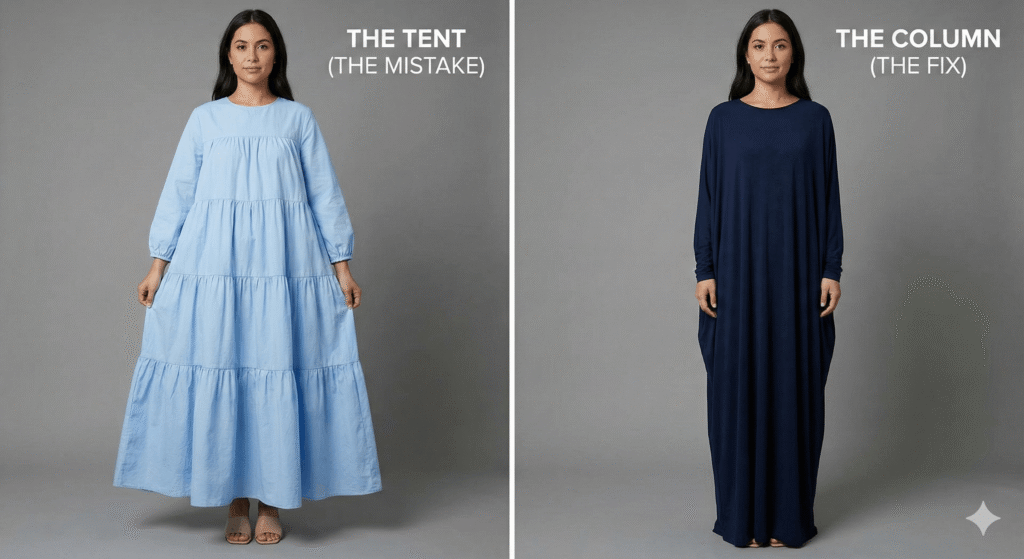
The “Tent Effect” happens to short women when a dress makes a single, undefined block of color from shoulder to toe, or worse, cuts the body in a way that makes it look shorter.
The 2/3 to 1/3 Ratio The goal of petite styling is to create a visual ratio where your legs look like they make up two-thirds of your body, and your torso makes up one-third.
- The Mistake: Drop-waist dresses. A drop waist lowers the visual start of the legs, making your torso look long and your legs look stumpy. For a short woman, this is fatal to the silhouette.
- The Fix: Empire waists or natural high-waists. By raising the waistline of the dress to sit just under the bust or at the smallest part of the natural waist, you trick the viewer’s eye. You are saying, “My legs start here.” Even if your legs actually start six inches lower, the fabric flowing from that high waistline suggests a longer limb underneath.
The Column Effect When a petite woman wears a maxi dress, she is attempting to create a “Column of Color.” A continuous line of color is the most powerful lengthening tool in existence. It forces the eye to travel vertically without interruption.
The reason you feel like a “tent” is often because the dress has horizontal volume that counteracts the vertical length. If a dress is wide and long, you are a square. If a dress is narrow and long, you are a line. We want to be a line.
Part 2: The Architecture of the Neckline
Most people look at the hem first. That’s wrong. The neck is where the body starts to stretch.
If you are 5’2″, you can’t afford to waste space. Every inch of skin or fabric needs to have a purpose. For small women, high necklines like crew necks and turtle necks on a maxi dress can be dangerous because they “cap” the column. They put a cap on the vertical line.
- The Scoop and the Deep V A V-neck is the best thing for a small woman. Why? Because it goes down. It makes an arrow that pulls the eye up and down toward the center of the body. It shows off your collarbone and neck, which adds two to three inches of “skin space” to your height. In a V-neck maxi dress, the eye measures your height from the top of your head to the floor. When you wear a high neck, the eye looks from the chin down. Just by opening the neckline, you look taller.
- The Off-Shoulder/Bardot This draws a horizontal line across the shoulders. While we generally avoid horizontal lines, this one works because it highlights the neck and collarbones, which are usually delicate features. It reduces the “mass” of the fabric.
- The Halter Neck A halter neck draws the eye upward and inward, narrowing the shoulders slightly and creating a long, triangular line that points to the face. It creates a beautiful verticality.
The “Tent” Warning: Avoid high-neck, sack-like dresses with no waist definition. If you cover your neck, your wrists, and your ankles, and the dress is loose, the brain registers the image as “blob.” You must show the articulation points of the body to prove there is a human inside the fabric.
Part 3: The Danger of the Hemline (Visual Anchoring)
Let’s talk about the bottom of the dress. This is where the panic sets in.
The “Floor Sweep” vs. The “Ankle Graze” There is a misconception that the longer the dress, the taller you look. This is only true up to a point. If a dress drags on the floor, pooling around your feet, two things happen:
- The Puddle Effect: You look like a child trying on mommy’s clothes. It signals that the garment does not fit you, which subconsciously emphasizes your smallness.
- The Visual Anchor: A heavy hem weighs you down. It pulls the eye to the floor.
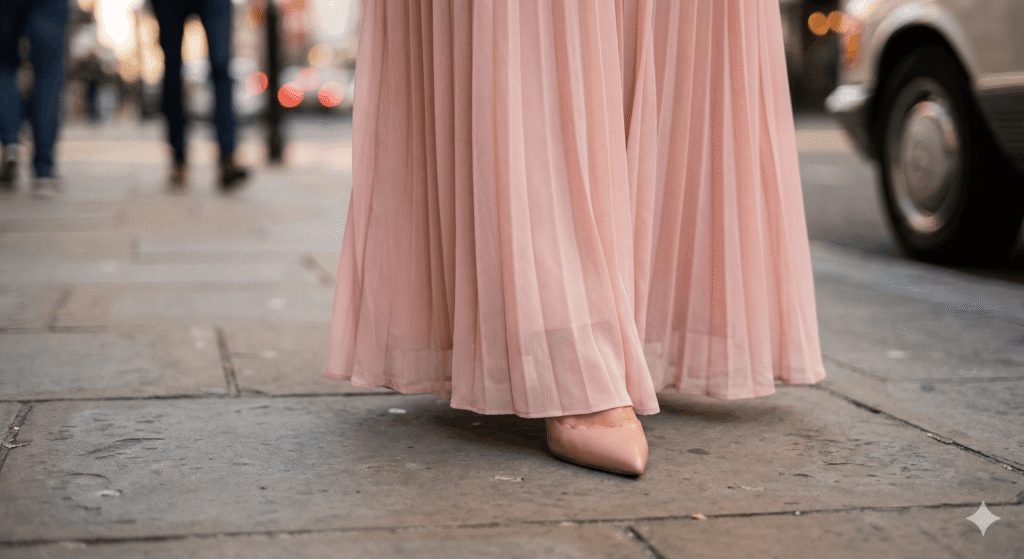
The Sweet Spot: The perfect maxi length for a petite woman is roughly half an inch off the ground (if wearing flats) or brushing the top of the toe box (if wearing heels). You want the fabric to hang straight without buckling or folding at the bottom.
The High-Low Hem (The Petite Cheat Code) If you are terrified of the full maxi, look for a “High-Low” or “Tulip” hem.
- Why it works: It gives you the drama and flow of a maxi dress at the back, but the front rises to reveal a bit of shin or ankle. This break in the fabric prevents the “swallowed up” feeling. It shows leg, which breaks up the mass of the skirt, making the whole garment feel lighter and airier.
Part 4: Fabric Science – Weight and Volume
This is the billion-dollar insight that most stylists miss. The material of the dress is just as important as the cut.
The Volume Paradox A petite frame can be easily overwhelmed by bulk. Imagine a maxi dress made of thick, stiff cotton poplin or heavy wool. It stands away from the body. It adds width. If you add two inches of width to a 5’2″ frame, you look significantly wider than if you add two inches to a 5’10” frame.
The Rule: You want Drape, not Volume.
- Good Fabrics for Petites:
- Rayon/Viscose: These are semi-synthetic fibers made from wood pulp. They are heavy enough to hang straight down but fluid enough to move with the body. They do not “poof” out. They collapse against the skin.
- Silk/Satin: Creates a sleek, vertical line.
- Jersey (High Quality): Heavy jersey falls beautifully. It has weight, so gravity pulls it down, elongating the look.
- Chiffon/Georgette: Light and airy. Even if there is a lot of fabric, it is translucent and moves, so it doesn’t look like a solid block of cement.
- Bad Fabrics for Petites (in Maxi Form):
- Stiff Taffeta or Organza: These hold their shape. If the shape is wide, you will look wide.
- Heavy Corduroy or Thick Velvet: Too much visual weight. It looks like the dress is wearing you.
- Tiered “Cake” Skirts in Stiff Cotton: Horizontal tiers on a stiff skirt are basically a ladder of horizontal lines widening you at every step.
The “Tent” Antidote: If you love a voluminous dress, ensure the fabric is sheer or soft. If the fabric is stiff, the cut must be narrow (like a sheath or column dress). You cannot have stiff fabric and a wide cut. That is the recipe for a tent.
Part 5: The Print Illusion – Scale and Direction
“Petites should never wear prints.” False. Petites should not wear giant prints.
The Scale of the Print Imagine a dinner plate. Now imagine placing that dinner plate on a child’s chest. It covers the whole chest. Now place it on a large man’s chest. It looks like a saucer. This is relativity. If you wear a maxi dress with a massive, dinner-plate-sized floral print, your brain compares the size of the flower to the size of your body. If the flower looks huge, your body looks small.
The Strategy:
- Micro-Prints: Ditsy florals, small polka dots, or intricate geometric patterns are excellent. They create texture without dominating the frame.
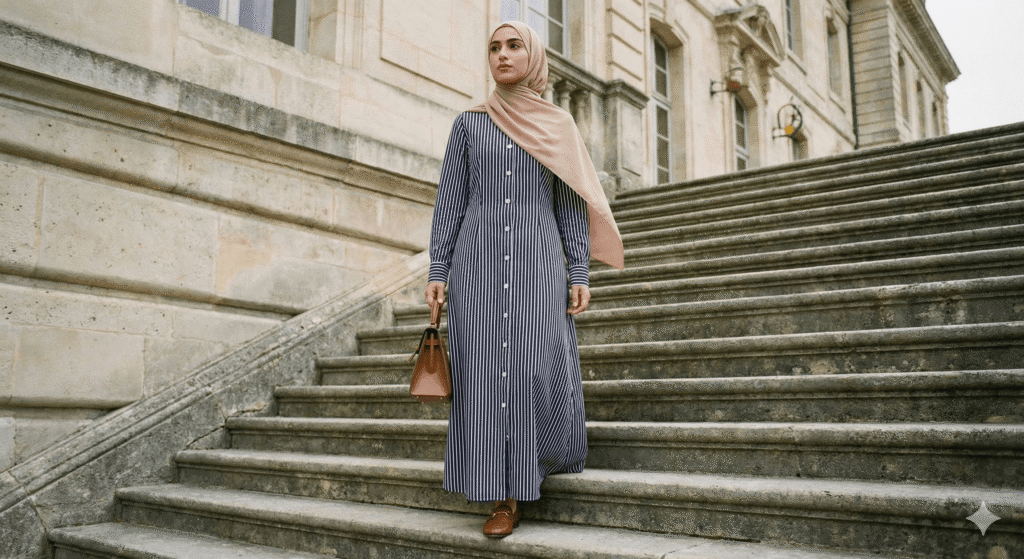
- Vertical Stripes: The oldest trick in the book, but effective. Thin, pinstripe-style vertical lines force the eye up and down. Avoid wide, jailhouse horizontal stripes.
- Solid Colors (Monochrome): The most effective tool. A solid block of Navy, Black, Burgundy, or Emerald Green creates that uninterrupted column we discussed in Part 1. If you want to look 3 inches taller instantly, wear a solid-color maxi dress.
Part 6: The Waist Styling Lab (Defining the Center)
You bought the dress. It’s a little loose. You feel “tent.” Don’t send it back yet. We need to do surgery on our hair.
The waist is where the petite woman and the maxi dress meet. The eye thinks that the width of your bust goes all the way to your hips if your waist isn’t defined. We need to show that this isn’t true.
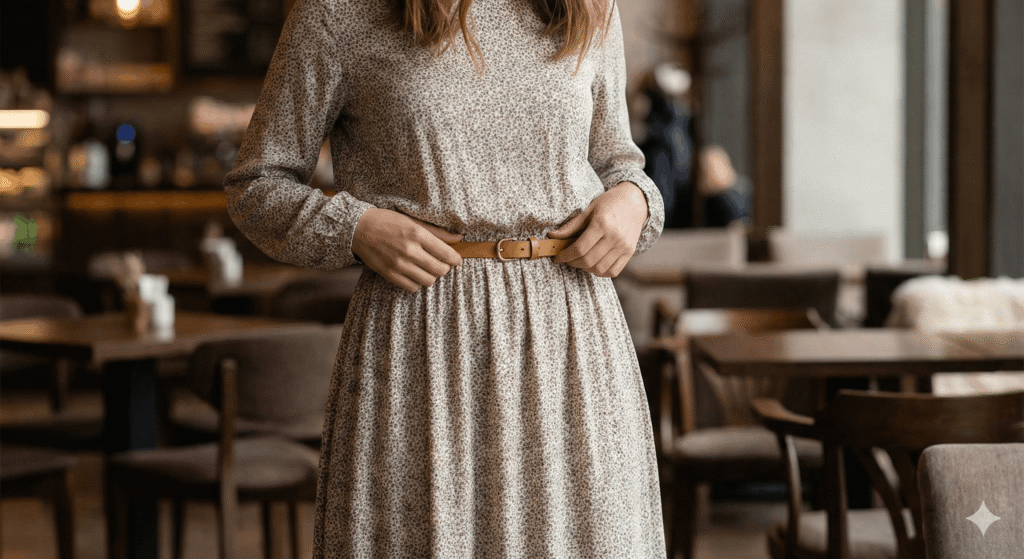
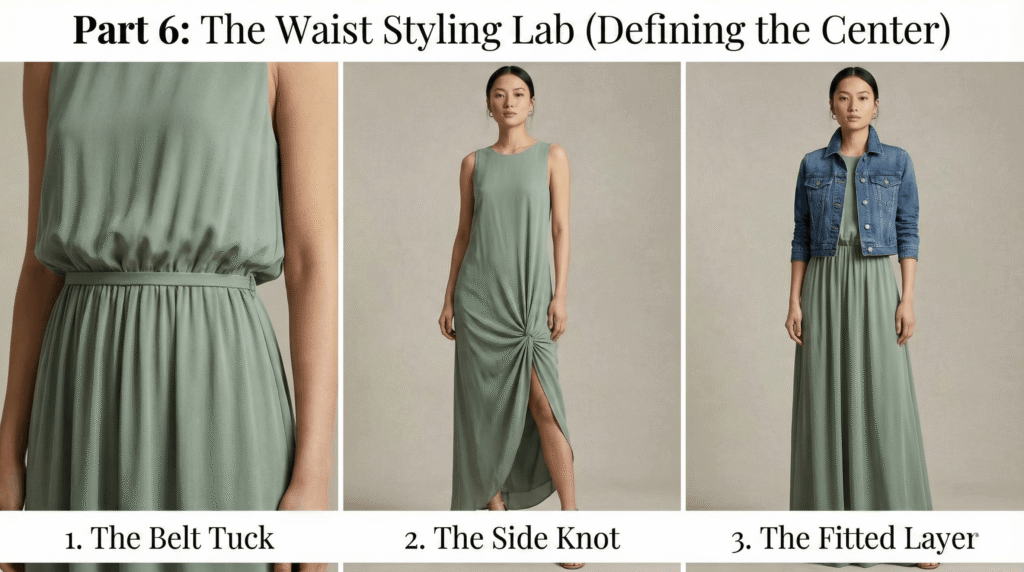
- The Belt Tuck Do not just put a belt over the dress. That cuts you in half. Use a belt to blouse the dress.
- Technique: Put a thin belt around your natural waist (high up). Pull the fabric of the dress up through the belt so it spills over slightly, hiding the belt.
- Result: This shortens the dress (fixing the length issue) and defines the waist without creating a harsh horizontal line. It creates a soft, Grecian silhouette.
- The “Side Knot” If the dress is jersey or a soft cotton blend and is too long, grab a handful of fabric at the thigh/knee area on one side. Twist it and tie it into a knot (using a clear elastic band inside to secure it).
- Result: This pulls the hemline up on one side (asymmetry elongates!). It also pulls the fabric tight across the hips/waist, showing your figure, turning a sack into a draped masterpiece.
- The Fitted Layer If the dress is loose, wear a structured piece over it.
- The Cropped Jacket: A denim jacket or leather blazer that ends exactly at your waist (not your hips). This artificially implants a waistline onto a loose dress.
- The Corset Belt: Very trendy and very effective for petites. It flattens the fabric against the torso.
Part 7: The Shoe Theory (What Happens Under the Skirt)
The beauty of a maxi dress is that nobody knows what is happening underneath. It is a magician’s curtain.
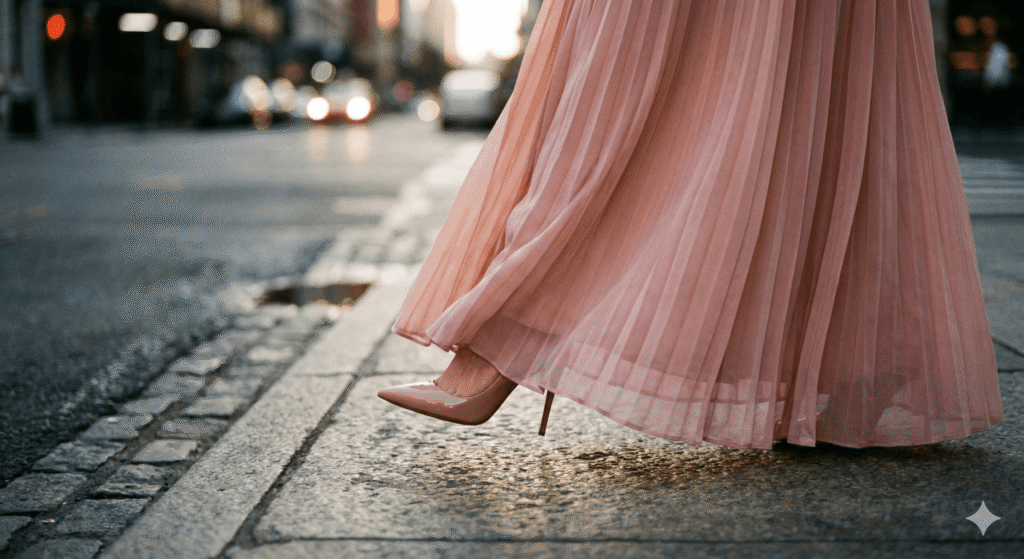
- The Hidden Platform You do not need to wear painful stilettos. A wedge or a flatform sandal gives you 2–3 inches of height, and because the dress covers the shoe, nobody sees the chunky sole. You just magically appear taller.
- The Pointed Toe If the hem rises when you walk, and your toes are visible, opt for a pointed toe.
- Physics: A round toe stops the eye. A pointed toe extends the line of the foot. It’s a small detail, but these micro-adjustments add up.
- Nude vs. Contrast If your feet are visible, wear shoes that match your skin tone (“nude”). This makes your foot look like an extension of your leg. Black shoes on pale skin (or vice versa) create a “stump” effect at the bottom of the column.
Part 8: The Tailor – Your Secret Weapon
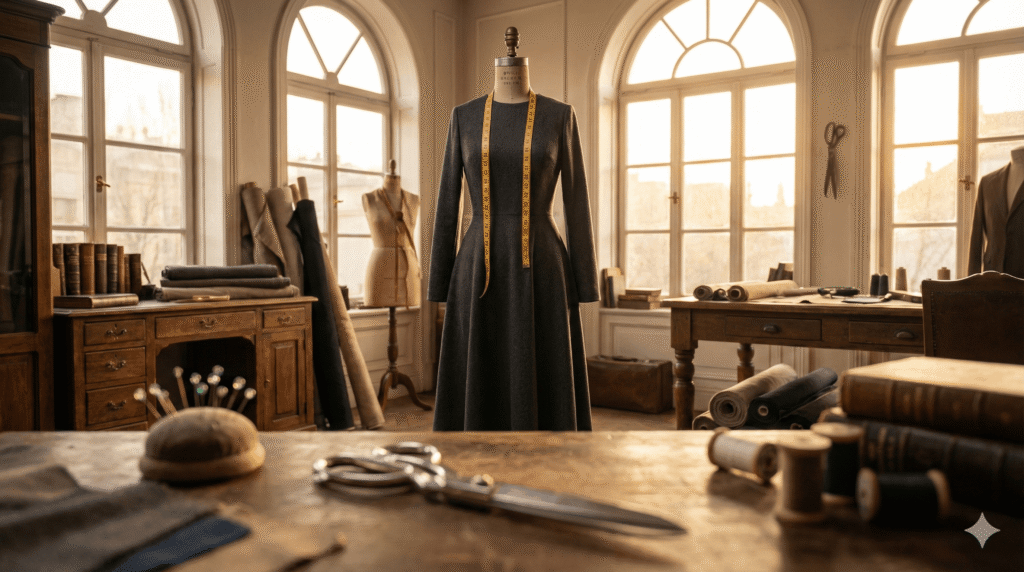
We need to talk about “off-the-rack” clothes in a serious way. Ready-to-wear clothes are all about averages. It is made to fit the average person in the demographic. If you are small, you are, by definition, not average.
It’s like expecting a random key to unlock your house if you think a maxi dress will fit you perfectly off the rack. It could happen, but it’s not very likely.
A $15 hem job can make a woman look “short” in a maxi dress or “chic.”
The “Hemming” Tax Petite women must accept that the price of the dress includes the price of the alteration. Factor it in.
- What to ask for: “I want this hemmed to graze the floor when I am wearing these specific shoes.” (Always bring the shoes to the tailor!).
- Shoulder Lift: Sometimes the dress is too long in the torso (the armholes hang low, the neckline is too deep). Ask the tailor to “lift the shoulders.” Taking up the straps or shoulder seams by an inch lifts the entire dress, raising the waistline and the hemline in one go.
Fashiorial Tip: If you don’t sew, use Iron-On Hem Tape. It is a double-sided adhesive strip. You fold the fabric inside, place the tape, and iron it. It melts the glue, sealing the hem. It is a permanent fix that costs $5 and requires zero sewing skills. You can do this in your bedroom in 10 minutes.
Part 9: Modesty and The Petite Frame
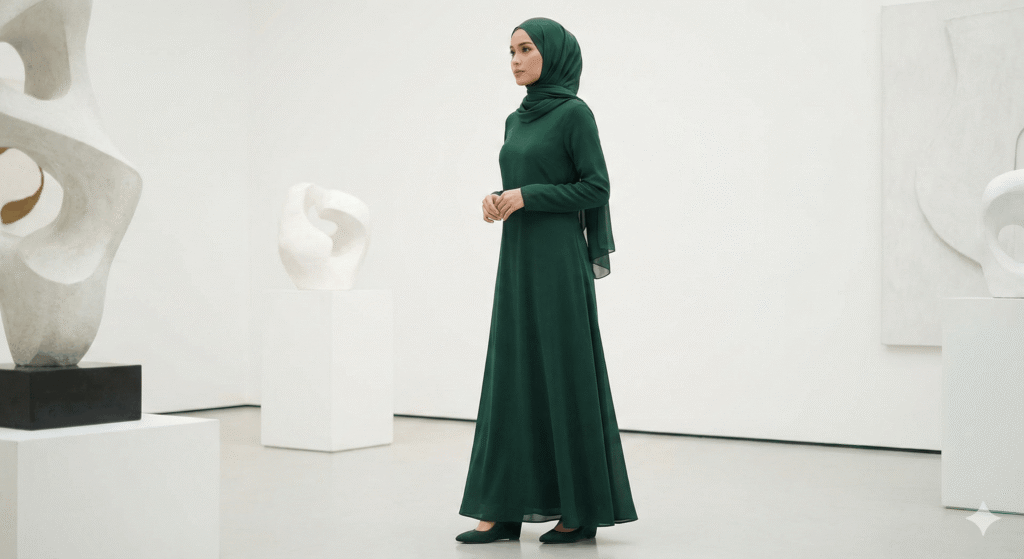
At Fashiorial, we know that many of our readers value modesty. The challenge with modest fashion for petite women is that “more fabric” usually equals “shorter look.”
How do you cover up without drowning?
- The Monochromatic Layering Hack If you are wearing a maxi dress and need to wear a long cardigan or Abaya over it, ensure they are the same color.
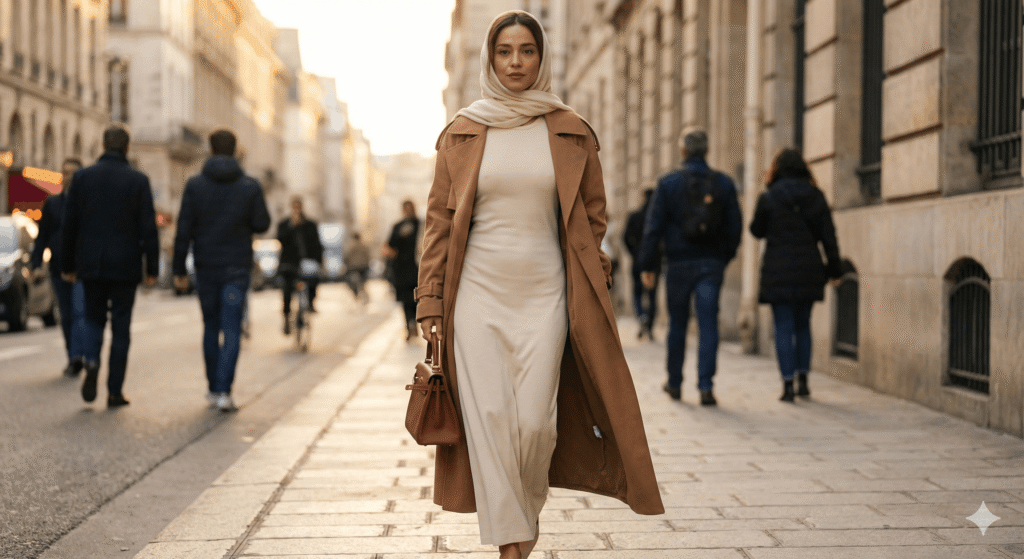
- Why: If you wear a white dress and a black Abaya, you create vertical stripes (good), but if the contrast is too harsh, it can look busy. A beige dress with a camel coat creates a soft, luxurious, continuous line.
- The Hijab/Headscarf Integration If you wear a hijab, match the color of the hijab to the dress.
- The Continuous Line: Imagine a woman in a black maxi dress and a black hijab. The line of color goes from the top of her head to the floor. She looks infinite.
- The Contrast: If she wears a black dress and a white hijab, the eye stops at the neck.
- Tucking Styles: For maxis, try a turban style or a neatly tucked hijab style rather than a voluminous, draped style that covers the chest. We want to keep the chest area open (visually) to maintain that Rule of Thirds ratio.
Part 10: Shopping Guide – Keywords to Filter By
When you are shopping online, stop scrolling aimlessly. Use the filters. Be a sniper, not a machine gunner.
Search/Filter for these terms:
- “Petite” Category: This isn’t just shorter lengths; the armholes and waists are adjusted.
- “Empire Waist”: As discussed, the best friend of the short girl.
- “Wrap Dress”: The diagonal line of a wrap dress is universally flattering and lengthening.
- “Slit”: A side slit breaks up the volume.
- “Adjustable Straps”: Vital for lifting the neckline.
- “Smocked Bodice”: Usually means the top is tight and fitted, allowing the skirt to flow. Great for defining the torso.
Avoid these terms:
- “Oversized”: Code for “Tent.”
- “Drop Waist”: Code for “Short Legs.”
- “Boxy”: Code for “Square.”
- “Tea Length”: This length (mid-calf) cuts the calf at the widest point and is notoriously difficult for petites unless styled perfectly with heels. A full maxi or a knee-length is safer than the ambiguous tea-length.
Reclaiming the Narrative
Let’s go back to the room where we got dressed.
You are wearing the dress. It’s too long. It’s too large. But now you know what to do.
You take out a belt and tie it high on your ribs, making the fabric puffy. The waist shows up. You can show your wrists by rolling up your sleeves or pushing them to your elbows. The structure shows up. You stand on your toes, like you would if you were wearing wedges. The hem floats. To show your neck, you pull your hair up or tuck your hijab. The column is done.
You don’t look like a kid playing dress-up anymore. You look like a queen.
Fashion isn’t about changing your body to fit the clothes; it’s about changing the clothes to fit your body. The “Petite Problem” isn’t about how tall you are; it’s about how big you are. And you just figured it out.
We at Fashiorial think that style can be found at any height. Buy the maxi dress now. Get the longest, most dramatic gown that touches the floor. You now have the tools you need. The fabric doesn’t hide you anymore; it shows you.
Put on the dress. Don’t let the dress control you.